
Emergency Garage Door Repair Near Me: What Fairfield Homeowners Should Do First
Forcing a garage door open after a spring breaks doesn’t just risk injury. It can strip the cable drum, bend the top section, and turn a $280 spring job into a $900 multi-component repair. The 20 minutes between the failure and your phone call are the most consequential part of the whole episode, and what you do in that window decides whether the fix stays straightforward or compounds itself. Below is a decision tree, not a pep talk: identify the failure, secure the door, then call someone who works on garage doors only.
If you’d rather skip the triage and get a specialist on the line, call (877) 584-2814. We answer 24/7, with fast dispatch from 7am to 7pm, Sunday through Friday.
First: Identify Which System Actually Failed
Most homeowners call and say “my door is broken.” Technicians hear something more specific, and so can you, because a spring failure, an opener failure, and a cable failure each announce themselves differently. Getting the diagnosis roughly right before you dial means the person on the phone can give you an accurate ETA and a realistic price range on the first call, which is the entire point of doing this in order.
- Spring system. A torsion spring is the horizontal coil above the door on the header; extension springs run alongside the tracks. A visible gap in the coil, or a door that suddenly weighs what feels like 200 pounds, points here. Do not lift it to test that theory.
- Opener. The motor runs but the door doesn’t move, or the door moves a foot and reverses. A Chamberlain or Genie unit that hums without travel is usually a gear, capacitor, or travel-limit issue, not a door problem.
- Cable. A snapped cable usually leaves a loose steel strand coiled near the drum and the door hanging crooked. Cables are under tension too, so treat a dangling one as dangerous, not as debris.
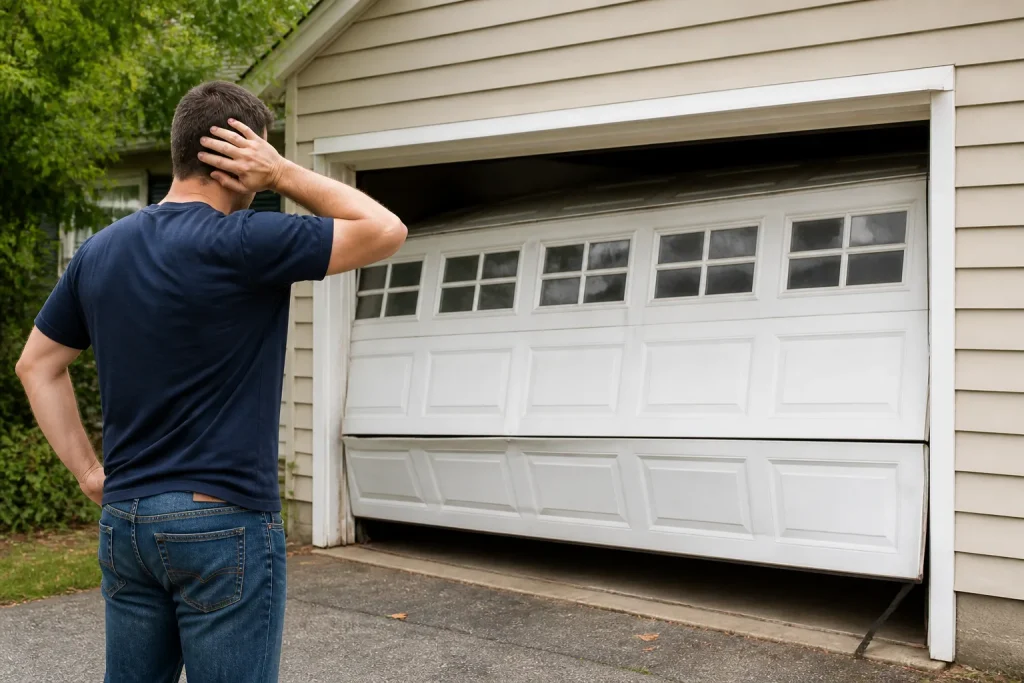
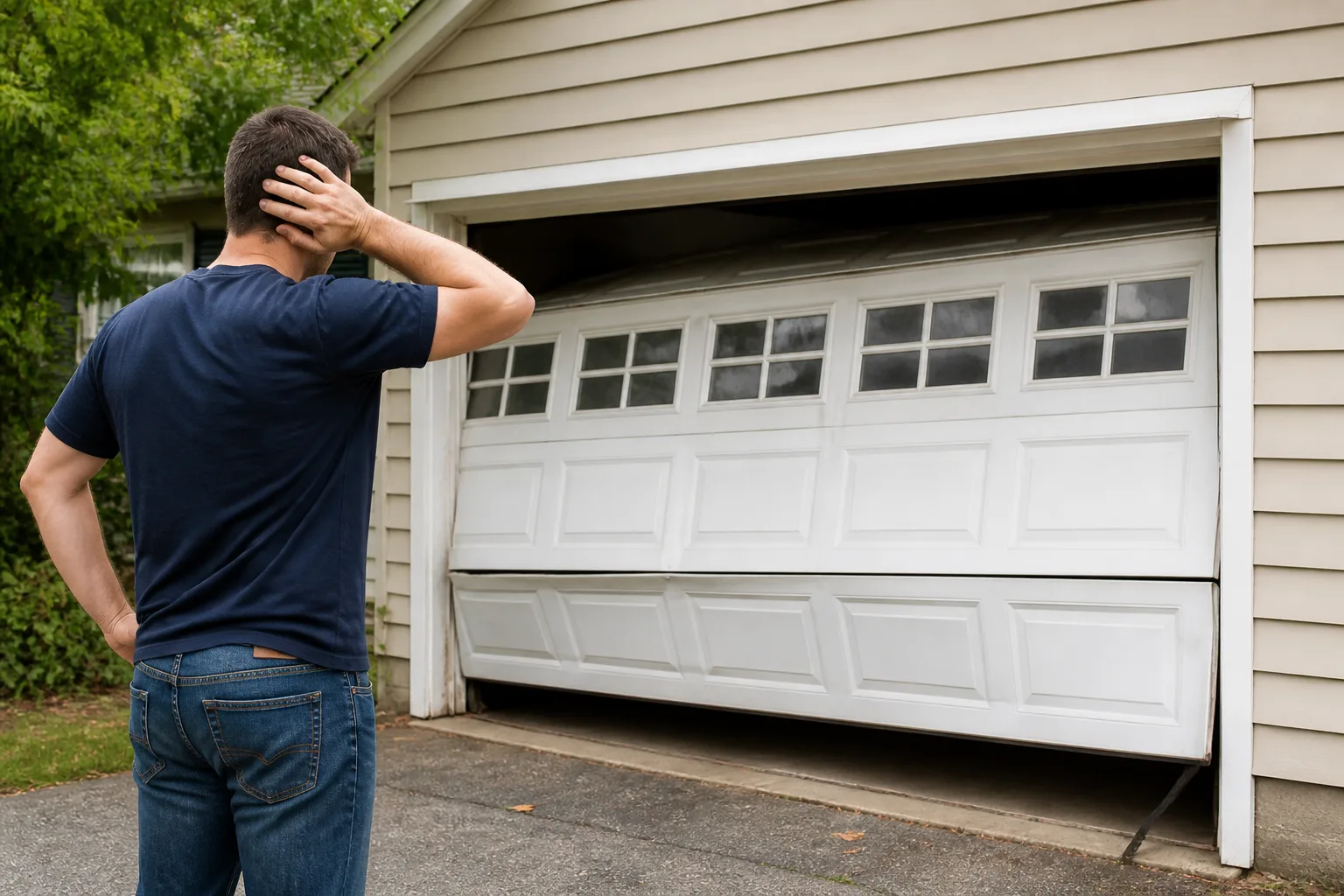
- Tracks and rollers. A door jammed mid-travel with one side higher than the other often means a bent track or a roller popped out of the channel. This is the one category you can sometimes see clearly without touching anything.
If you’re unsure which of these you’re looking at, that’s normal, and it’s fine to say so on the phone. A technician who handles garage door repair every day will ask two or three questions and know.
Do This Before You Call, Not After
Here’s the sequence that keeps a bad situation from getting worse. It takes about two minutes and it protects both you and your door.
- Stop pressing the button. Repeatedly cycling a door with a broken spring drags the opener through a fight it can’t win and can burn out the motor in the process.
- Unplug the opener if the door is stuck mid-travel. This prevents an accidental activation while you’re near the door.
- Don’t force the door up or down by hand. On a door with a failed torsion spring, the full weight is unsupported. People get hurt this way, and the door usually gets bent in the process.
- Don’t cut or untangle a cable. Cables hold serious tension and can whip when released. Leave them alone.
- Note what you see, then step away and make the call.
One genuinely useful piece of equipment to know about: the manual release cord. It’s the rope hanging from the opener’s rail, usually with a red handle. Pulling it disengages the opener from the door so you can move the door by hand. That’s the correct move when the power is out or the opener has failed but the door itself is mechanically sound. It is not the right move when a spring has broken, because pulling the release on a spring-broken door drops the full weight of the door onto you. If the door is heavy or the spring looks broken, the cord stays hanging.
Why the First “24-Hour Garage Door Repair” Result Isn’t Always Local
Search “emergency garage door repair near me” in Fairfield and the top of the page fills with names that sound local and often aren’t. Plenty of those listings are national dispatch operations: a call center answers, takes your information, and subcontracts the job to whatever independent technician is available, with a markup built in for the referral. You end up paying more and talking to a company that has never seen your door brand, your track setup, or your street.
A few ways to tell the difference before you commit:
- Ask directly whether the person answering the phone is dispatching their own technicians or forwarding the job.
- Ask whether they work on your specific opener brand. A specialist will name it and describe the common failure points without hesitating. A call center will read from a script.
- Ask for the price range for a broken torsion spring over the phone. A local specialist who does garage door spring repair all week can give you a real range. A dispatcher will dodge.
- Look at whether the site talks about garage doors exclusively or lists them alongside roofing and gutters.
We’re a garage-door-only company, which means every technician we connect you with spends their whole week on doors and openers, not on a dozen unrelated trades. We work on the brand you already have, whether that’s Chamberlain, Genie, Clopay, or something older in the garage. If you’re dealing with an opener that’s misbehaving rather than a door that’s jammed, the specifics are worth reading on our garage door opener repair page before you call.
Have This Information Ready to Get a Real ETA on the First Call
The difference between a vague call and a useful one comes down to four or five details. Have these on hand and the person dispatching a technician can tell you what’s likely wrong and roughly what it will cost before anyone gets in a vehicle.
- Door width and type. A single-car door is usually 8 or 9 feet wide; a double is typically 16 feet. Sectional, roll-up, or one-piece matters too.
- Opener brand. LiftMaster, Chamberlain, Genie, Craftsman, Raynor, and others fail in different ways. If you can read the label on the back of the motor housing, even better.
- Whether a spring is visibly broken. A clean gap in the coil is confirmation. If you can’t see one, say so.
- Where the door is stuck. Fully closed, fully open, or partway up, and whether it’s sitting level or crooked.
- Your address and whether the door is the only way in. If it’s your primary entry point, that changes the urgency of the dispatch.
Grab that information before you dial and you’ll get a straight answer instead of “we’ll have someone call you back.” If you’re not sure of a detail, technicians can work around it; the brand name alone goes a long way.
If Your Door Is Stuck Open and You Can’t Get Same-Day Help
A door stuck open is a different problem from a door stuck closed. You’ve got a hole in the side of your house and a lot of expensive tools on the other side of it. Interior door locks don’t address that. A few practical steps while you wait for a technician:
- Park a vehicle close to the opening, nose in, to block the line of sight and approach.
- Remove anything valuable, small, or easily carried from the garage, especially bikes, tools, and anything visible from the driveway.
- If the door is partially down and stable, don’t try to lower it further. An unsecured door is more dangerous than an open one.
- If the door is fully open and level and the opener is disengaged, some homeowners can guide it down manually with a second person, but only if the springs are intact and the door isn’t heavy. If it feels heavy, stop and wait for the technician.
None of this is permanent, and none of it should delay a call. A door that’s been sitting open for hours in Fairfield has a way of attracting attention you’d rather not have. Call (877) 584-2814. We answer 24/7, with fast dispatch from 7am to 7pm, Sunday through Friday. If a door fails on a Saturday, call and we’ll book you into Sunday. For the full scope of what we handle, from spring work to installation, see Fairfield Garage Door Repair Pros.
When to Call a Pro and When to Leave It Alone
Some garage door issues are genuinely DIY territory: reprogramming a remote, adjusting the safety sensors, replacing a battery in a keypad. Those are safe and don’t involve stored energy. Here’s where to draw the line and call someone.
- Springs. Torsion and extension springs store energy that can cause serious injury if released improperly. Spring work is not a homeowner job. Call a technician.
- Cables. Cables under tension can slice through a hand when they let go. Don’t handle them.
- Anything involving the door panel’s weight. If the door feels heavy or the spring is broken, don’t lift it. A door that collapses on its own can break bones.
- Opener replacement or repair. A failed opener isn’t usually dangerous, but matching a new unit to the door’s weight and travel is fussier than it looks. A technician with the right tools resolves it faster.
Our technicians have up to 13 years of experience, and spring work is a large part of what they do, so we’ve seen just about every way a spring failure plays out. If the diagnosis turns out to be a bigger problem than you thought, an opener that’s failing, for example, we can handle that in the same visit rather than sending you to a second company. If a repair turns into a full replacement, we do garage door repair before we ever recommend a new door, and we can carry a job from repair through installation on the same visit if needed. From opener fix to full installation is one company.
The Bottom Line
The key steps after a garage door failure are: stop pressing the button, don’t force the door, identify roughly which system failed (spring, opener, cable, or track), have your door width, opener brand, and spring status ready, and call a garage-door-only specialist rather than the first national listing that appears. A door stuck open needs temporary security steps. The 20-minute window before the call is where unnecessary damage happens, so use it well.
If you’re in Fairfield and need help, Fairfield Garage Door Repair Pros offers free estimates and prices quoted and agreed before any work starts. Call (877) 584-2814. We answer 24/7, with fast dispatch from 7am to 7pm, Sunday through Friday. Plan on garage doors only.
Frequently Asked Questions
Typical ranges depend on the failure: a broken torsion spring runs roughly $180 to $340 per spring, an opener repair is usually $120 to $280 depending on the part, and cable or track work falls in the $150 to $350 range. A pair of springs replaced together costs about twice the single-spring figure. A free on-site estimate confirms the exact price, which is quoted and agreed before any work begins. Call (877) 584-2814 for an exact quote; estimates are free.
Often, yes. Garage door failures tend to be same-day or next-day work because a door that won’t close isn’t something you can leave open. A call before mid-afternoon has the best chance of getting a technician out the same day. Call (877) 584-2814. We answer 24/7, with fast dispatch from 7am to 7pm, Sunday through Friday.
Not if the job matches the diagnosis. The estimate is set by a written quote, and that’s the price you pay. If, once on site, the technician finds a second failure you couldn’t have seen, like a cable that was weakened when the spring broke, you’ll be told before any extra work starts and given the revised figure to approve. Nobody adds work to an invoice you didn’t agree to. Call (877) 584-2814 for an exact quote; estimates are free.
No. Once a spring has broken or the door is stuck mid-travel, stop operating it. Repeatedly pressing the opener on a door with a failed spring stresses the motor and can break a cable drum or bend the top panel, turning a simple repair into a several-hundred-dollar job. Unplug the opener, leave the manual release cord alone unless the springs are intact, and wait for the technician. If the door is your only way in or out, that’s a reason to call sooner rather than later. Call (877) 584-2814 for an exact quote; estimates are free.
Written by the team at Fairfield Garage Door Repair Pros.
Need Garage Door Help?
Call Fairfield Garage Door Repair Pros - the local pro we connect you with is licensed and insured, here with fast help in Fairfield.
(877) 584-2814